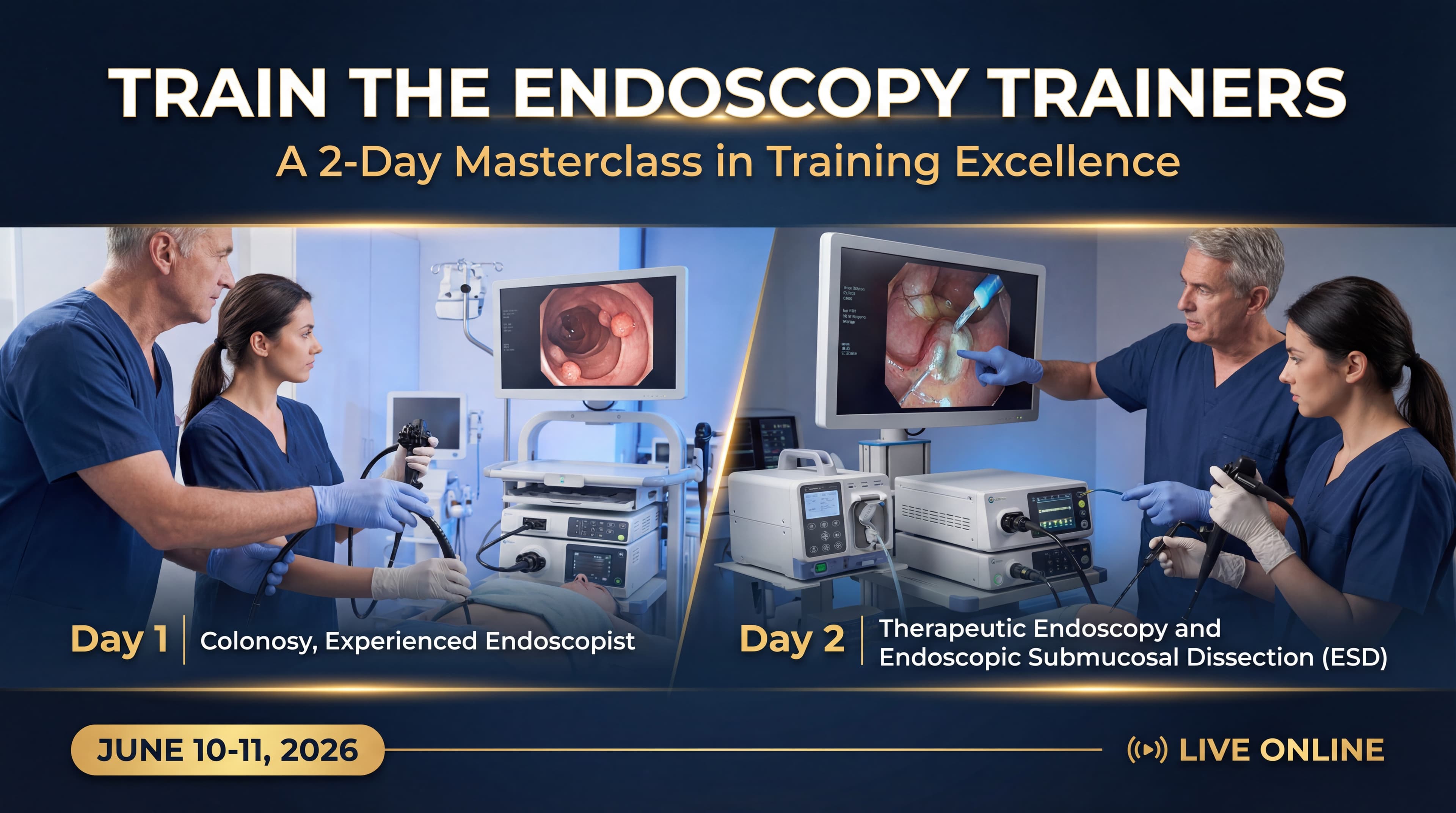
Train the Endoscopy Trainers — Day 2, Therapeutic (EMR & POEM)
Two colorectal resection cases (hepatic EMR, cecal sessile-serrated lesion) and two POEM cases, each with a structured video-augmented debrief — plus the GPAT and PPAT assessment-tool lectures, an EMR-simulator demo, a gamma-loop talk, a whole-faculty training-philosophy panel, and a closing round-table on training commonalities across colonoscopy and therapeutics. How training adapts as procedures get harder. 12 sessions. In-person €250 (10 seats), virtual €150 (60 seats), free with Pro back-catalogue.
Get Started Today
Buy This Content
One-time purchase
- Permanent access to this content
- Stream anytime, anywhere
GIEQs Pro
Unlimited access
- This content included
- 1,000+ videos & courses
- 14-day free trial, cancel anytime
- New content added weekly
What's in this Day 2 recording
The full broadcast feed from Day 2 of the TTT 2026 course at UZ Gent, cut into a structured catch-up library of 12 sessions: four therapeutic cases — two colorectal resections (EMR and a sessile-serrated lesion) and two POEMs — each followed by a structured video-augmented debrief, plus the assessment-tool lectures that frame the day, an EMR-simulator demo, a gamma-loop teaching talk, a whole-faculty training-philosophy panel, and a closing round-table on training commonalities.
Day 2 takes the same loop as Day 1 — trainer→trainee feedback on the recorded video, then super-trainer→trainer feedback critiquing the training — and applies it to therapeutic endoscopy. As the procedures get harder, the training language has to change. That is the explicit teaching point of the day.
Faculty
- Super trainers (observe the trainer, not the trainee): Dr David Tate (UZ Gent), Dr John Anderson (Gloucestershire), Prof Roland Valori (Gloucestershire).
- Trainers: Dr Nick Church (NHS Lothian), Dr David Tate (UZ Gent), Dr Lynn Debels (Belgium), Dr Pieter Jan Poortmans (Belgium).
- Trainees: Adam (Canadian fellow, UZ Gent), Luigi Tuccillo (Italian fellow, UZ Gent).
What's in the catch-up
- Opening & framing. Faculty welcome and the two-pronged framing of the day: competency assessment tools plus the training competency framework.
- Lecture — Competency Assessment Tools (GPAT). What a CAT is, how GPAT was built and scored, and a walk through its domains before the first case.
- Case 1 — Hepatic-flexure EMR (Adam / Nick / David). A ~50% circumferential lesion; an EMR-vs-ESD decision worked through live, converting to underwater piecemeal EMR. Final histology: high-grade dysplasia only — no cancer.
- Lecture — EMR Simulator & AI Rating Platform. A low-cost standardised polypectomy/EMR simulator and the AI platform that scores attempts — training tip control before the patient.
- Training Philosophy Panel — Case 1 group debrief (John-led). Whole-faculty discussion: clinical responsibility, cognitive load, didactic vs problem-analysis training, imposter syndrome, and the "shared list" upskilling model.
- Case 2 — Cecal Sessile-Serrated Lesion (Luigi / David / John). A residual SSL assessed in retroflexion; a case built around communication between trainer and trainee.
- Lecture — PPAT (POEM Assessment Tool). The ESGE POEM competency assessment tool — eight domains, video-based, for briefing, debriefing and remote mentoring.
- Lecture — Gamma-loop Resolution. A whiteboard talk on loop terminology, the two gamma-loop types, and supine-position resolution.
- Case 3 — POEM #1, achalasia (Adam / Lynn / David). A trainee taken through the myotomy under close coaching; the super-trainer debrief captures the overload moment and the hand-off.
- Panel — Commonality in training across colonoscopy & therapeutics. A faculty round-table closing Case 3: what is common in training across Day 1 colonoscopy and Day 2 therapeutics — the educational contract and control of the trainee, non-technical skills, and virtual preloading "as relevant for POEM as it is for EMR and colonoscopy".
- Case 4 — POEM #2, 22yo achalasia (Luigi / Pieter Jan / Roland). The final case — injection, mucosotomy and tunnel start by the trainee, with a strong video-review debrief.
- Wrap-up, group reflections & day close. Framework recap, reflections from every participant, and the close.
The day's headline
One loop, four times, across rising complexity — standard EMR, a manipulated serrated lesion, then two POEMs. The framework that coaches a polypectomy does not automatically scale to a myotomy. Watching the same trainer→trainee→faculty loop stretch across that range is the point of the day.
Who should attend
Trainers and senior fellows in therapeutic endoscopy who want a rigorous, structured way to coach trainees through complex procedures — and to critique their own training delivery on video.
Access
- Pro members — catch-up access included with back-catalogue.
- Non-Pro — €150 one-off purchase grants full access to all 12 sessions.
Train the Endoscopy Trainers — Day 2, Therapeutic (EMR & POEM)
One-time purchase