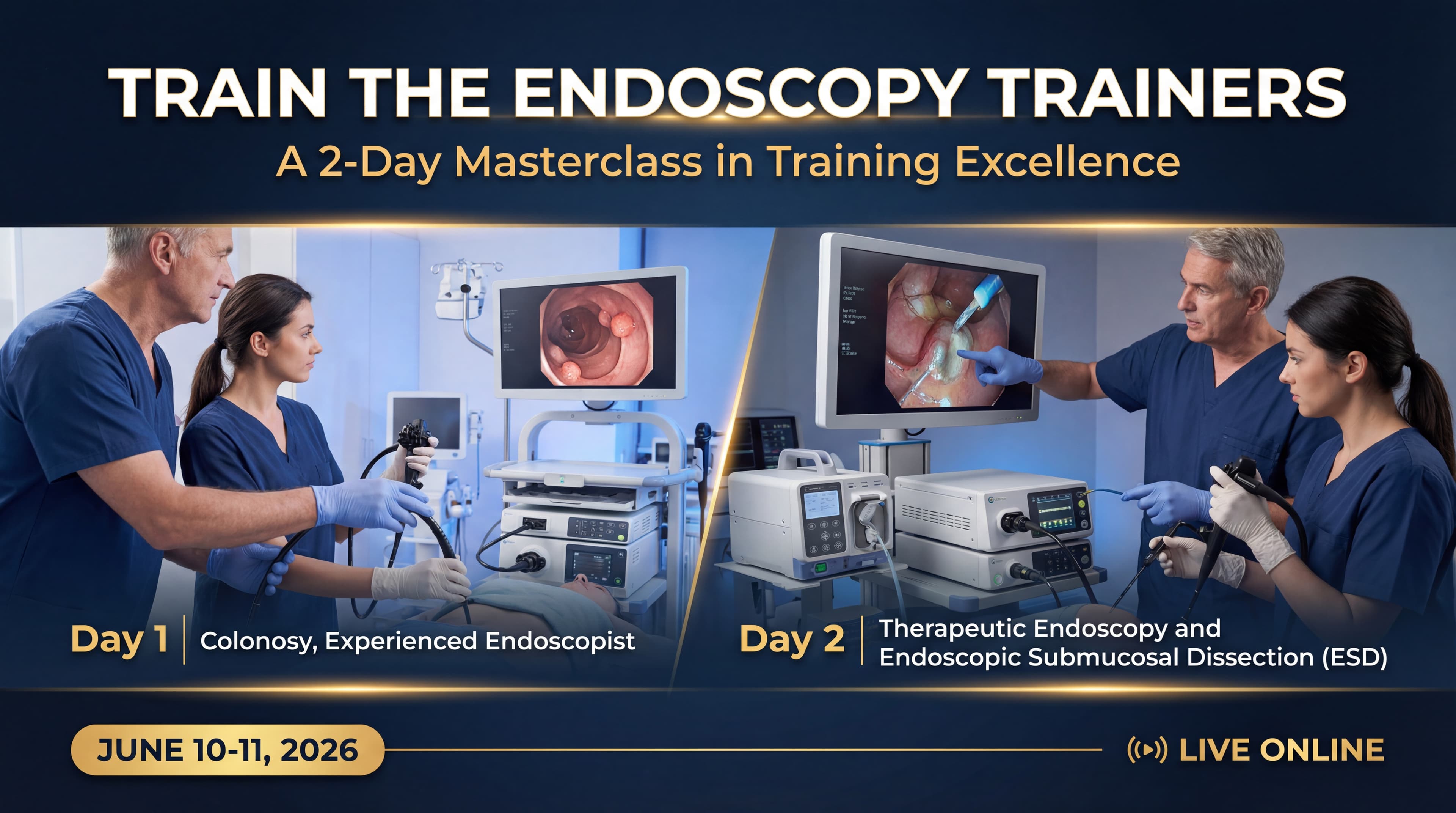
Programme Schedule
Colonoscopy Training — Live Cases with Video-Augmented Debriefs
09:20:00
Opening & framing — Faculty round-table
Roland and John give the course framing. Each faculty member introduces themselves and names what they want to get out of the day. Sets up vocabulary that pays off across the day. (~18 min)
10:35:00
Case 1 — FOBT-positive male (Adam / Manmeet / Roland)
59-year-old gentleman, FOBT positive. Adam (experienced Canadian fellow) trained by Manmeet; Roland super-trains. Educational contract focuses on conscious competence. Cecum in 90 seconds; one pedunculated polyp cold with injection, one small polyp on retroflex. Feedback deconstructs ergonomics gap, too-fast withdrawal, hand-off-scope retroflex technique (safety flag) and rushed polyp characterisation. (~75 min)
11:55:00
Case 2 — 50yo screening positive (Luigi / Nick / John)
50-year-old screening positive, propofol. Luigi (very experienced Italian fellow) — Nick's job is to push conscious competence, not teach scope skills. "Problem → solution → execution" (PASE) decision-analysis frame introduced. Retroflex-on-the-way-in, water immersion insertion, textbook N-spiral loop resolved with clockwise torque. Nick's super-trainer review with John drills the failed "innominate grooves" reference and how to detect when a trainee hasn't truly understood. (~80 min)
12:40:00
Case 3 — 50yo screening, diverticular (Cecilia / Pieter Jan / Roland)
50-year-old screening with diverticular disease. Cecilia (most junior trainee, Italian resident). Pieter Jan trained as the trainer (basic-level). Roland super-trains. Fast intubation but bad views; Buscopan ambiguity ("normally I wouldn't"). Roland's feedback drills missed instruction opportunities — failure to follow the trainee's lead, fast insertion at expense of views, polypectomy "haircut" analysis. (~45 min)
13:35:00
Case 4 — SC2 scar follow-up (Adam / Beth / John)
53-year-old SC2 site check; previous 35mm adenoma resected 2024 with CAST technique. Adam (second case of the day) under sedation — awake, French-speaking patient. Contract: loop avoidance, slowing down, position change, fine tip control. Includes N-spiral roll-to-back, water vs CO2 switching at splenic, and John's mid-case redirect to an underwater view of the scar from the right side. John's feedback: "control the trainee, not the scope" message; splenic-flexure algorithm laid out. (~54 min)
13:50:00
Peer discussion — Buy-in (Roland + John)
Delegate-requested side-bar between cases. Roland & John discuss what buy-in is, why trainees don't buy in (culture, muscle memory, belief, unit context), and how to engineer it — PASE algorithm, demonstration, "performance-dip" warning. The conceptual companion to the in-room moments. (~12 min)
.jpg?width=6000&height=4000&ext=.jpg) Elizabeth Bird-Lieberman
Elizabeth Bird-Lieberman14:40:00
Case 5 — Awake-patient SC after ESD (Luigi / Manmeet / Roland) — AFTERNOON EXEMPLAR
Surveillance after ascending ESD (curative pT1aSM1). Fully awake patient. The cleanest training case of the day — source of "I just pause you", "you're doing it unconsciously", the four-axis time-out ("hands · trainee · patient · scope"), Socratic question chain, and awake-patient communication ("This might be a bit uncomfortable — we're coming up to a bend"). The exemplar against which the morning cases are measured. (~50 min)
14:55:00
Peer discussion — Training levels & polypectomy upskilling (Roland + Beth + Manmeet)
Round-table on who should train (not-train / supervise / formal-train / super-train), the polypectomy training gap, dedicated upskilling lists, and the "shared list" approach between senior endoscopists (Oxford specialist-list model). (~14 min)
15:45:00
Case 6 — Awake, chronic diarrhoea, lipoma (Adam / Beth / John) — INCLUDES SAFETY REVIEW
70-year-old, no sedation (patient asked for awake). Adam (third case, pacey). Known colonic lipoma — "pillow sign" moment in sigmoid. Includes the patient-safety incident: Adam tries to unwind an external loop while a hook is still on at splenic, dragging tip into mucosa. Feedback walks the video through what happened, "when do we put loop in umbilicus" theoretical drill, plus missed ischaemic patches in the cecum spotted by John. Critical teaching block. (~50 min)
16:30:00
Case 7 — 50yo screening positive, awake (Cecilia / Beth / Roland)
Final case. Cecilia's second case — now more confident, awake patient. Designed to test position change + PASE on an awake patient. Scope-guide loop reading, sigmoid loop prevention by position change, lateral compression demo at splenic. Roland's feedback drills the missed PASE moment (miscommunication: sigmoid vs splenic) and introduces "facilitated tip-steering" — Cecilia never touched the left-right wheel in the left colon in either of her cases. Strongest single teaching moment of her two cases. (~47 min)
16:40:00
John's competency framework recap
John whiteboards the full competency framework: Preparation (contract / assessment / agenda / ergonomics / objectives) → Training (control / cognitive load / wide-angle lens / PASE / decision training / performance-enhancing training / clarity-of-language) → Feedback (PEF / consolidated take-homes). The conceptual through-line of the whole day. (~6 min)
17:00:00
Group reflections & day close
Roland goes round all trainees and trainers for a take-home reflection (Cecilia, Pieter Jan, Manmeet, Beth, Luigi, Nick), followed by Roland's day-close and preview of Day 2 (therapeutic endoscopy). (~15 min)
What's in this Day 1 recording
The full broadcast feed from Day 1 of the TTT 2026 course at UZ Gent, cut into a structured catch-up library of 12 sessions: seven live colonoscopy cases across three rooms, two peer-discussion round-tables that surfaced during the day, John Anderson's whole-day competency-framework recap, and the closing group reflections.
The thing that is different about this course is not the procedures. It is the loop: trainer→trainee feedback uses the recorded video; super-trainer→trainer feedback critiques the use of the video. That is the skill we are teaching. You see that loop run seven times in one day.
Faculty
- Super trainers (observe the trainer, not the trainee): Prof Roland Valori (Gloucestershire), Dr John Anderson (Gloucestershire).
- Trainers: Dr Manmeet Matharoo (St Mark's), Dr Nick Church (NHS Lothian), Dr Pieter Jan (Belgium), Dr Elizabeth Bird-Lieberman (Oxford).
- Trainees: Adam (Canadian fellow, UZ Gent), Luigi Tuccillo (Italian fellow, UZ Gent), Cecilia (Italian resident).
- Course director: Dr David Tate (UZ Gent) — deliberately hands-off on Day 1 ("today I am totally backed out of it") to let the day's training delivery speak for itself.
What's in the catch-up
- Opening & framing. Roland and John frame the course; each faculty member names what they want to work on.
- Case 1 — FOBT-positive (Adam / Manmeet / Roland). Smooth case; debrief drills ergonomics, retroflex technique, polyp characterisation pace.
- Case 2 — 50yo screening (Luigi / Nick / John). PASE (problem-solution-execution) framework introduced; textbook N-spiral loop resolution.
- Case 3 — Diverticular screening (Cecilia / Pieter Jan / Roland). Basic-level trainer training; Roland deconstructs missed instruction opportunities.
- Case 4 — SC2 scar follow-up (Adam / Beth / John). Awake, French-speaking patient. Includes John's mid-case redirect to an underwater scar view.
- Peer discussion — Buy-in. Why trainees don't buy in; engineering buy-in with PASE; the performance-dip warning.
- Case 5 — Awake-patient SC after ESD (Luigi / Manmeet / Roland) — afternoon exemplar. Source of "I just pause you", "you're doing it unconsciously", the four-axis time-out, awake-patient communication. The cleanest training case of the day.
- Peer discussion — Training levels & polypectomy upskilling. Who should train; the "shared list" approach; Oxford specialist-list model.
- Case 6 — Awake lipoma case (Adam / Beth / John) — includes safety review. Patient-safety incident: unwinding an external loop with hook on at splenic. John spots missed ischaemic patches in the cecum. Critical teaching block.
- Case 7 — Awake screening (Cecilia / Beth / Roland). Cecilia's second case; introduces the "facilitated tip-steering" lesson — she never touched the left-right wheel in the left colon across either of her cases.
- John's competency framework recap. Preparation → Training → Feedback structure on the whiteboard. The conceptual through-line of the whole day.
- Group reflections & day close. Take-homes from every trainee and trainer; preview of Day 2 (therapeutic endoscopy).
The day's headline
The three rooms ran independently. The two morning rooms missed most of the in-room training framework the pre-course webinar named. The afternoon room modelled them. Same framework, same day, two outcomes — projected side by side, the contrast reads itself. That contrast is the headline of Day 1.
Pre-course webinar
The 1 June pre-course webinar (purchased separately, €30, free with Pro) sets up the conscious-competence framework, training language, and the video-as-tool methodology used throughout this day. Recommended companion viewing.
Access
- Pro members — catch-up access included with back-catalogue.
- Non-Pro — €150 one-off purchase grants full access to all 12 sessions.
What you will leave with
- A repeatable structure for using continuous video to coach colonoscopy trainees, watched run seven times in one day.
- The four-axis time-out (hands · trainee · patient · scope), modelled live by Manmeet in Case 5.
- The PASE (problem-solution-execution) decision-analysis frame and ten in-the-moment variations from the afternoon exemplar.
- An honest pattern-recognition library — what training looks like when the framework is being skipped, and what it looks like when it is being baked into every case.