Programme Schedule
Upper GI — oesophageal and gastric ESD deconstructed
08:15:00
Welcome and course structure
08:30:00
Upper GI ESD: assessment of Barrett's, cardia and gastric lesions
10:15:00
Live case 1: stomach, 25 mm corpus-antrum adenoma
10:30:00
REACT multipoint traction: how we do it (Pieter Jan Poortmans)
12:15:00
Live case 2: gastro-oesophageal junction, high-grade dysplasia
12:45:00
Lunch
14:30:00
Live case 3: prepyloric stomach, 25 mm Paris IIa+c lesion
14:45:00
Case discussion
16:30:00
Live case 4: Barrett's oesophagus C6M6, nodule with high-grade dysplasia
17:00:00
Wrap-up, course evaluation and close
Deconstructed ESD — Day 2: Upper GI
Thursday 19 November 2026 · UZ Gent, Belgium · live from the endoscopy rooms
ESD is usually taught as one continuous technique. Over two days at UZ Gent we take it apart. Day 2 is upper GI — Barrett's, the gastro-oesophageal junction and the stomach: every case is worked through the same sequence of decisions — how the lesion is assessed before a knife is picked up, where the EID goes if the resection has to be oncologically sound, how traction is set up and when it is worth the time it costs, and what to do when the plane runs out and the resection becomes knife-assisted full-thickness.
What is demonstrated
- Lesion assessment and the decision to proceed — Barrett's nodules, junctional and gastric lesions
- Oncological placement of the EID
- Submucosal traction — set-up, cost in time, when it earns its place
- Traction in the oesophagus and stomach
- Gastric ESD in an atrophic stomach
Two techniques at the centre
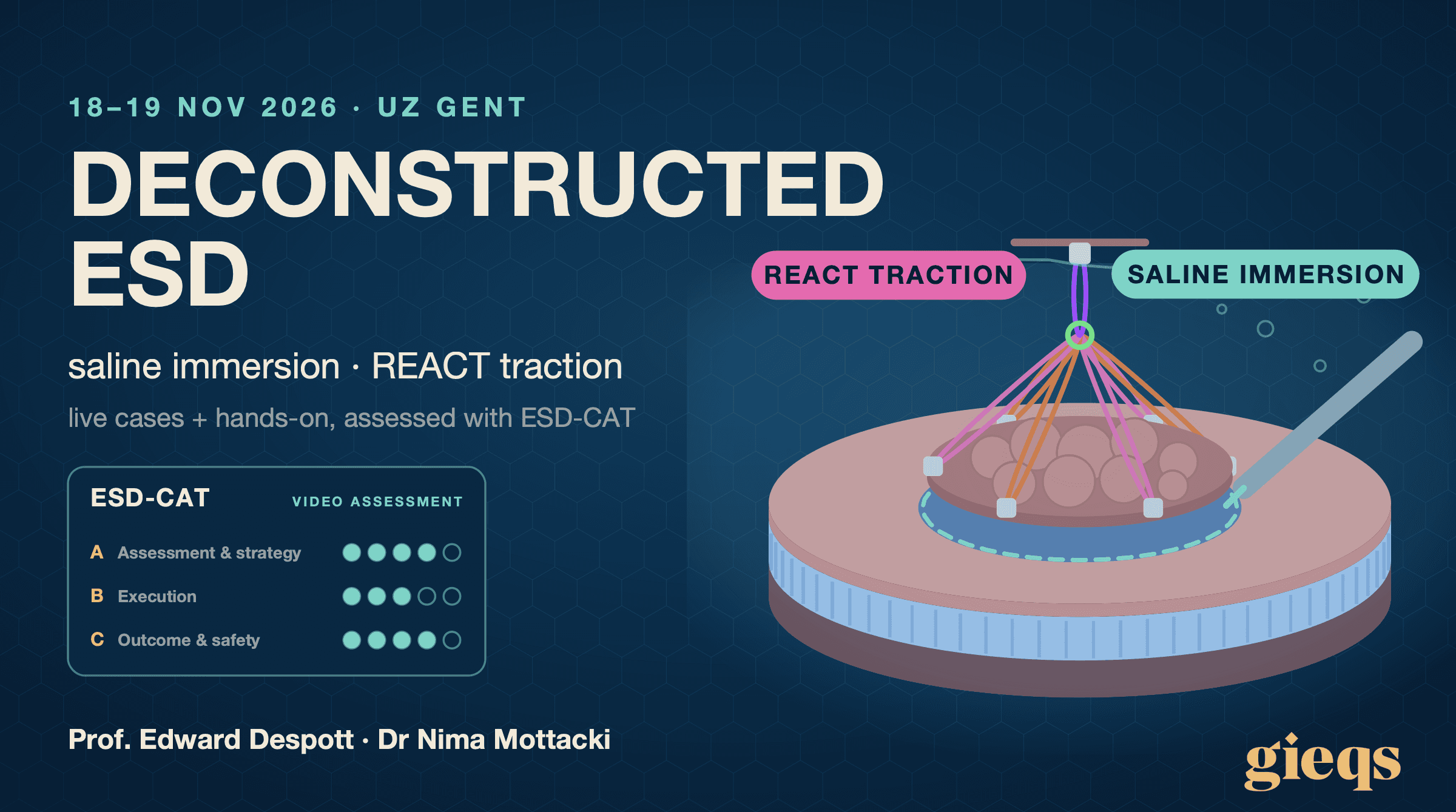
- Saline immersion — dissecting under saline: buoyancy opens the submucosal space, the view stays clear, and haemostasis is more controlled.
- REACT multipoint traction — the repositionable elastic traction system developed at UZ Gent (react.gieqs.com; Gastrointestinal Endoscopy 2025, 59 consecutive colorectal ESDs). Built from low-cost elastic bands and re-openable clips, adjusted as the dissection progresses.
Hands-on, assessed on video
Every hands-on case is recorded and scored with the ESD-CAT, the new ESD competency assessment tool (live and video modes, entrustment-anchored, built on the ESGE ESD curriculum). Participants leave with a structured assessment of their own case, not just a certificate.
Faculty
- Prof. Edward J. Despott — Royal Free Unit for Endoscopy, Royal Free London / UCL
- Dr Nima Mottacki — Sahlgrenska University Hospital, Gothenburg
- Prof. David J. Tate and the UZ Gent tissue-resection team
Format
Four live cases transmitted from the endoscopy rooms with faculty commentary, two in the morning and two in the afternoon, with short lectures between cases: upper GI lesion assessment and REACT multipoint traction. Day 1 (Wednesday 18 November) covers lower GI. Day 2 closes at 17:00.
Who it is for
Endoscopists performing EMR and building towards ESD, and ESD operators who want the component skills isolated.
Attendance
| Option | Per day | Places |
|---|---|---|
| Virtual (live stream + catch-up) | Register on this page | Open |
| Live, observer | €100 | 10 |
| Live, hands-on | €250 | 6 |
Hands-on places require prior agreement on preparation. For live attendance or a hands-on place, email [email protected].
RIZIV/INAMI accreditation has been applied for. With the support of Fujifilm, Pentax and Olympus.
Registration
GIEQs Pro members: Access is included. Otherwise, buy virtual access here and use this page again on course day.